
Galveston Parole Versus Probation
Parole and probation place a person in the community under rules, but they arise from different decisions. Texas parole follows a prison sentence and a favorable release decision by the Board of Pardons and Paroles. Mandatory supervision is another state release form governed by statute and Board review. TDCJ's Parole Division then manages the releasee. Probation, called community supervision in Texas law, is ordered by a trial court and managed through the local community supervision department. It may begin without any TDCJ prison stay.
That split determines where to verify a Galveston County supervision record. A TDCJ number, parole certificate, or state-prison history points toward BPP and the Parole Division. A county judgment that says community supervision points toward the court and Galveston County supervision office. Do not infer probation from a parole result, or parole from a county docket.
| Question | Parole | Probation |
|---|---|---|
| Who orders it? | Texas Board of Pardons and Paroles | The sentencing court |
| Who administers it? | TDCJ Parole Division | Local community supervision department |
| Best first record | TDCJ parole review or status information | Judgment and court docket |
| How it ends | Discharge, revocation, or sentence expiration | Court discharge, revocation, or term completion |
- Parole
- Conditional release from state prison before the sentence fully expires.
- Community supervision
- The Texas legal term commonly called probation.
- Mandatory supervision
- A statutory state release process based on time served, credits, eligibility, and Board action.
- Discharge
- Formal completion of the sentence or supervision term.
Verify Galveston Post-Release Supervision
Start with the custody system that produced the release. For a former Texas prisoner, use the BPP parole-status resources. The public status may distinguish parole, mandatory supervision, a pending review, or discharge. Identity matters. Match the TDCJ number and supporting facts before relying on a same-name result. For probation, search the Galveston County court case and read the judgment because the court, not BPP, created that term.
- Identify whether the person left the county jail, a TDCJ unit, or another system.
- For a TDCJ case, use the state number and BPP status channel. The Parole Status Line is 844-512-0461, and the main BPP office is 512-406-5452.
- For county community supervision, locate the Galveston County judgment and later docket entries through the originating clerk.
- Read the release certificate or court order for the assigned office. Geography alone does not choose the reporting site.
- When completion is the issue, request the discharge or termination record from the agency that imposed or administered supervision.
A favorable Board vote is not proof that the person has left a prison. TDCJ still reviews the release plan, legal requirements, program needs, and required conditions before issuing a release certificate. Likewise, a probation judgment establishes a court status but may not state the exact time someone left the Galveston County Jail. Pair legal records with the custody release record when timing matters.
Galveston Release Supervision Offices
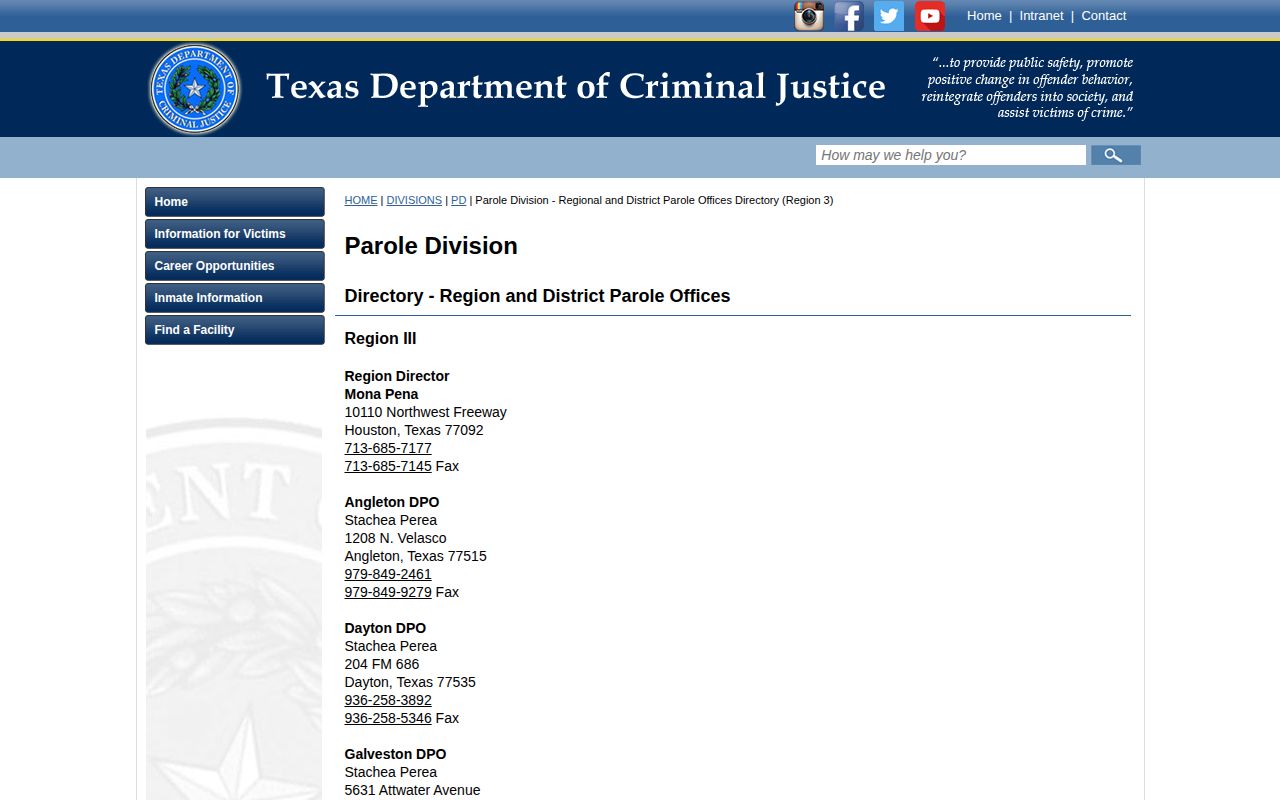
TDCJ places Galveston County in Parole Region III. Its directory names the Galveston District Parole Office in Dickinson and also lists a Webster office. Those listings help a caller reach the state system, but the release certificate and assigned officer control where a releasee must report.
Galveston District Parole Office
Address: 5631 Attwater Avenue, Dickinson, TX 77539
Phone: 409-943-1500
Fax: 409-945-6000
TDCJ Region III office directory
The same directory lists the Webster DPO at 12454 Highway 3, Webster, TX 77598, with phone 281-212-8500. Neither address proves assignment. County probation remains a separate court-based route. The judgment and community supervision record are the sound sources for that status.
The official Region III listing can be reviewed before calling:
Galveston Supervision Status Changes
Conditions may require reporting, travel approval, program participation, or other conduct set by the certificate or court order. The exact terms are individual. An alleged violation can produce investigation, a warrant, a revocation process, or a return to custody. A new Galveston County booking may appear in P2C while the state parole matter proceeds on a separate track.
An absconder is a person alleged to have stopped complying with required supervision, often by failing to report or remain available. It is not a label to infer from a missing online address. Verify the status with the supervising agency or warrant authority. GCSO's wanted-person navigation is not a complete state parole-warrant list, and disappearance from the current jail roster does not clear a warrant.
Galveston Supervision Discharge Records
Supervision may end through successful completion, sentence expiration, a court order, or revocation. “Released” and “discharged” are not synonyms. A person can be released from a facility while still on parole or probation. Discharge means the identified legal obligation has ended, subject to what the formal record says.
For state supervision, ask TDCJ or BPP for the public status and discharge context tied to the TDCJ number. For probation, obtain the judgment plus the later order or docket event that records completion or termination. The Galveston County released-inmate search and records path explains how to pair those legal records with the jail's release or transfer entry.
Galveston Parole Review Outcomes
Ordinary Texas parole consideration is a file review, not a public courtroom-style hearing. An Institutional Parole Officer prepares case material, and a three-member panel requires two concurring votes. A denial may include the next review date. An approval can carry programs, a future date, or special terms that must be met before release.
BPP uses short decision codes. Favorable “FI” variants can impose a date, program, or condition. “NR” and “CU” variants set or continue review. “DMS” denies discretionary mandatory supervision, while “serve all” directs confinement to the stated release or discharge point. Public Board meeting agendas are governance records, not a calendar of individual Galveston County release hearings. The person's TDCJ Parole Review Information and the status line are the better sources.
Where Galveston Parolees Report
The office name can mislead. The Galveston District Parole Office is not on Galveston Island. TDCJ lists it in Dickinson near the Carole S. Young Medical Facility. The local geography also puts Webster within reach, but convenience does not alter assignment.
A releasee should follow the certificate and instructions from the assigned officer. Family members seeking to confirm a public office listing may call the directory number without telling a person to report based on a map. This distinction also prevents confusion between state parole and Galveston County community supervision, which begins with a county court order.
Compare Galveston Supervision Records
Three records can describe one person without saying the same thing. The GCSO release record shows when county custody ended or transferred. A court judgment shows whether community supervision was ordered. TDCJ and BPP records show state parole, mandatory supervision, review, or discharge. Record each source and the date checked before drawing a conclusion.
The court route lasts longer than a live jail entry. Galveston County's Odyssey portal can show judgment, probation or deferred-adjudication status, motions to revoke, and later disposition events. Those are legal case events. They do not give the exact jail-door time, just as a release log does not explain the full court result.
Texas IVSS may send a custody or court-event notice, but the notice still reflects the contributing agency. Keep the message as a lead. For proof of completion, ask for the discharge document from TDCJ or the terminating order from the court. A release from one booking does not itself end supervision or clear another warrant.
Galveston Parole Decision Timing
A BPP review date should not be reported as a release date. The panel may deny release and set a later review, or issue a favorable decision with conditions. Even an approval can require a treatment program, an approved plan, residence review, or certificate processing. Physical release occurs only after the applicable work is complete.
The public status line can clarify whether a vote is pending, favorable, denied, or tied to a later review month. Ask with the state number. Avoid using public Board meeting dates as a substitute because those meetings concern Board business, not an ordinary person-by-person parole calendar.
Mandatory supervision also needs exact wording. For eligible modern offenses, BPP may approve or deny discretionary mandatory supervision. A denial can move the projected date toward maximum expiration. Record the published decision code and seek clarification from the state instead of translating every denial into a permanent refusal.
Revocation is separate from the ordinary file review that considers release. An alleged violation may lead to a warrant and a revocation hearing, while a new Galveston County arrest can create a county booking at the same time. Check both systems. P2C may show the new local custody event, but TDCJ or the supervising authority must explain the state supervision action. A person can leave the county jail on the new charge and still face an unresolved parole hold.
County community supervision has its own proof. The Galveston judgment establishes the original term, and later docket entries may record a motion to revoke, an amended condition, or completion. Request the final court order when the end date matters. A clerk's case status should not be recast as a TDCJ parole status.